

Over the last few years, one lesson has become impossible to ignore. The biggest steps forward I have seen in unmanned systems and autonomy have not come from the technology by itself. They have come from the conversations around it.
The breakthroughs that stick usually start with founders working through what it takes to get a real customer to adopt. With investors pushing past the deck to understand where value truly concentrates. With engineers pressure testing assumptions and challenging each other to rethink what is possible. With operators, customers, and partners being honest about what works in the field and what fails under real constraints.
As the industry consolidates and innovation accelerates across platforms, autonomy stacks, and mission profiles, the path from promising capability to repeatable, profitable revenue remains anything but linear. The teams that win are the ones that translate vision into market reality, early and often.
After more than 15 years in this space, the pattern is clear: teams that collaborate across disciplines, reduce silos, and build relationships with intent move faster and execute better than teams trying to solve everything alone.
When those connections are in place, product market fit becomes clearer, go-to-market decisions improve, meaningful partnerships are formed, and scaling feels less reactive and more deliberate.
Rethinking What Networking Really Means in the Drone Industry
For founders and investors in autonomy, robotics, and unmanned systems, networking is often misunderstood. It is not about volume, visibility, or collecting contacts. It is about relevance.
The most valuable connections are rarely the loudest. They are customers who can articulate real operational pain, domain experts who understand constraints and tradeoffs, and investors who bring context rather than capital alone.
Trust, empathy, and mutual value are what sustain these relationships over time. As the industry matures and becomes increasingly specialized, networking when done well becomes one of the most effective ways to uncover unmet needs and identify where genuine differentiation still exists.
Assembling Your Network With Intent
A few principles have proven consistently useful over time.
Being clear on who you need at your current stage matters. Founders tend to benefit most from early customers, channel partners, and aligned investors. Investors benefit from operators, market intelligence, and trusted technical perspectives.
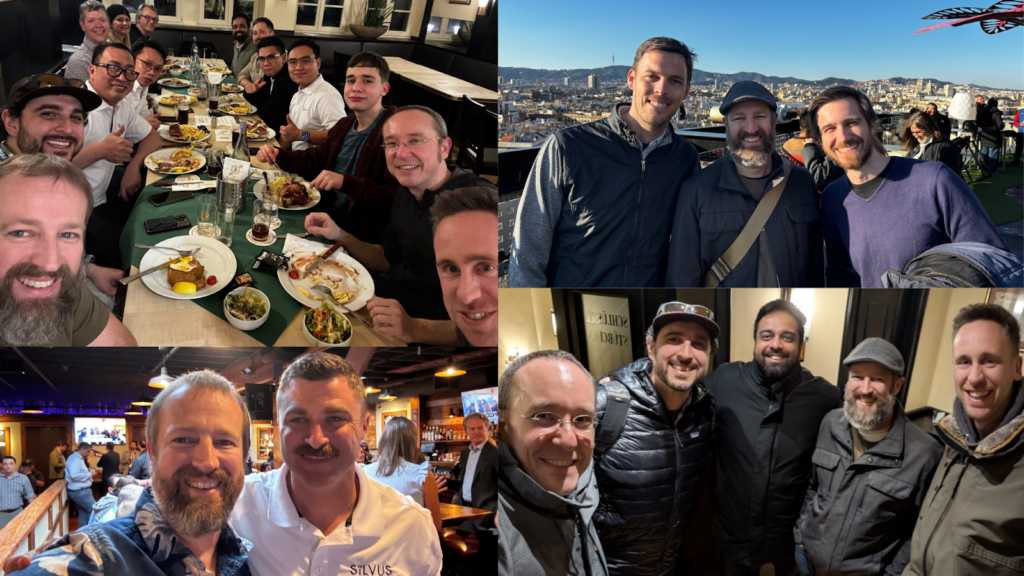
Using events and communities thoughtfully also matters. Face-to-face conversations, often over a shared meal or an unstructured discussion, compress learning in ways online interactions rarely do.
Add group dinner pic
Offering value before asking for anything builds credibility early. Sharing insight, making an introduction, or offering a perspective often opens doors long before a transaction is ever discussed.
Informal conversations should not be underestimated. Coffee chats frequently surface the most honest feedback and the clearest signals about market readiness.
Exploring partnerships and co-demos can also be powerful. Some of the most effective moments I have seen, particularly earlier in my career at Insitu, came from teaming with others to create shared wins rather than competing for attention.
Warm introductions remain one of the highest-leverage tools for both founders and investors in this ecosystem. And above all, consistency matters. Relationships compound through steady, thoughtful engagement, not one-off outreach.
One habit I have found especially useful is avoiding broad, generic pitching. Instead, I often lead with a simple question about what challenge someone is dealing with right now. That question almost always yields more insight than a polished deck.
A Practical Way to Think About Networks in Unmanned Systems
Over time, I have stopped thinking about networking as a single activity and instead view it as a system with distinct layers. Well, I can’t fully put aside my engineer brain. 😉
In the unmanned systems industry, the strongest networks tend to span three layers.
The market truth layer includes operators, customers, regulators, and program managers. These conversations surface what actually constrains adoption, including budgets, safety culture, procurement friction, and operational risk.
The translation layer includes integrators, consultants, and experienced operators who help convert technical capability into something deployable, repeatable, and fundable.
The capital and scale layer includes strategic investors, primes, and acquirers. This layer influences how quickly a solution can scale, survive market shifts, and reach long-term outcomes.
Most stalled companies I have encountered are not short on connections. They are overweight in one layer and underexposed in another.
Learning Through the Ecosystem
Over the past year, I have intentionally spent time across a wide range of industry events, field days, forums, and working sessions, easily more than a dozen across different regions and market segments. The goal was never simply to attend, but to listen, compare perspectives, and understand how the unmanned systems industry behaves on the ground, not just on paper.
Being present at large international gatherings such as XPONENTIAL in both USA and Europe and Commercial UAV Expo, alongside smaller regional and industry-focused events, has reinforced how differently autonomy is approached depending on geography, regulation, industry maturity, and end-user expectations.
The conversations I have had in Houston do not sound the same as those in Düsseldorf, Munich, North Dakota, Canada or the Pacific Northwest, and that contrast is where real insight emerges!
Panels, judging roles, and informal discussions with founders, operators, investors, regulators, and integrators consistently surface the same truth. Technology alone rarely determines outcomes. Context does. Market readiness, procurement pathways, operational culture, and risk tolerance all shape whether a solution gains traction or stalls.
Attending these events is less about visibility and far more about pattern recognition. Repeated exposure to how teams pitch, how operators push back, and how investors frame risk sharpens judgment over time. It also strengthens relationships that continue well beyond the event itself, often evolving into follow up conversations, introductions, or long term collaboration and relationships that can span decades.
This continuous engagement across the ecosystem directly informs how I support clients, helping them pressure test assumptions, refine positioning, and navigate regional differences with greater clarity and confidence.
The Network as a Long Term Growth Engine in the UAS Industry
In unmanned systems, the right network becomes a practical advantage. It speeds up team building, sharpens go to market decisions, validates product market fit earlier, and helps companies scale in regulated environments without constantly relearning the same lessons.
The way I approach this work stays grounded in a few principles: trust, curiosity, experience, and empathy.
If you are building in autonomy or investing across UAS and want a clearer view of the landscape, I am happy to connect. The right conversation often creates the clarity you need to move forward.