
Most unmanned systems teams can explain what their technology does. Far fewer can explain, in a few sentences, why a COO or CFO should care enough to fund it.
I have spent years working alongside operators, founders, and enterprise teams trying to move drones out of demos and into real operations. In most cases, the technology is solid, and the capability is clear. Where things tend to break down is when the conversation shifts from what the system can do to why it deserves budget, internal support, and long-term ownership.
That is where many good drone products stall. The aircraft works. The payload is amazing. The demo lands. But the story never reaches the boardroom in a way that leadership can confidently back.
If you cannot connect your capability to uptime, cost, risk, or whatever your customer values most, you stay in pilot mode.

This article is Part 1 of a two-part series on turning unmanned systems from promising capability into funded, scaled enterprise operations.
This first part focuses on how to think and talk like your customer’s COO and CFO.
From Technical Features to Business Outcomes
When teams are deep in autonomy, sensors, or BVLOS concepts, it is natural to lead with performance metrics. Range, endurance, payload, resolution, and algorithmic sophistication all matter.
The people approving budgets, however, are usually asking a different set of questions.
- Will this reduce operating costs in a measurable way?
- Will it reduce safety, regulatory, or operational risk?
- Will it unlock revenue or capability we cannot reach today?
- How quickly will this investment pay for itself compared to other options?
Note: If you want to dive deep into these topics, we have explored them in some other articles. Check them here.
That means every technical claim needs a financial translation.
For example:
- “60% faster inspections” becomes “cut inspection labour by 20 to 30 percent, saving $X per site per year, while freeing teams for higher value work.”
- “High fidelity 3D models” becomes “earlier detection of defects, avoiding rework and delays that typically add 10 to 15 percent to project costs.”
- “BVLOS capable” becomes “fewer crew deployments and travel days to remote assets, trimming both OPEX and safety exposure across the portfolio.”
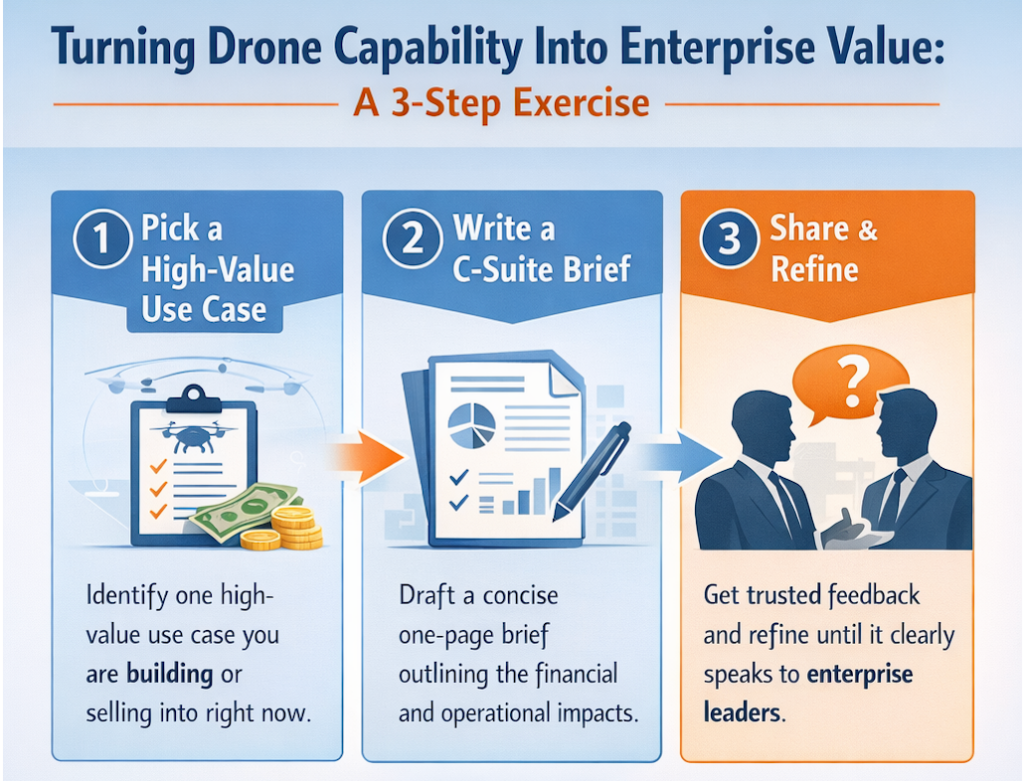
When roadmaps, sales narratives, and marketing consistently make these translations, teams stop sounding like technology vendors and start sounding like partners who understand how the business actually runs.
A Simple C‑Suite Question Set
Here’s a practical framework your team can use when scoping new capabilities or building your next deck.
Ask and answer these questions as if you were your customer’s COO and CFO:
Enterprise need and pain
- What specific enterprise outcomes are at stake: uptime, margin, safety KPIs, regulatory exposure, customer SLAs?
- Where is the business currently bleeding time, money, or reputation?
Tasks, workflows, and cost savings
- Which tasks are automated, augmented, or eliminated by your unmanned capability?
- How many hours, truck routes, confined-space entries, or site visits does that realistically remove per week or per asset?
New data, better decisions
- What decisions become faster or more accurate because of the data you collect (maintenance, planning, pricing, staffing)?
- Where does that show up in the P&L: fewer outages, less scrap, better asset utilization, higher throughput?
Total cost to integrate
- Hardware, software, training, change management, regulatory compliance, internal champions. What is the real cost to stand this up and keep it running?
- How much disruption occurs during rollout, and how do you minimize it?
Long-term financial impact and risk
- Over 3–5 years, what cost curves bend for your customer, and by how much?
- Which risks are reduced: safety incidents, environmental events, regulatory findings, reputational hits?
ROI vs alternate investments
- How does your solution compare to “do nothing,” “improve current process,” or “buy a different automation tool”?
- Where is your payback period and IRR clearly superior, and can you prove it with a pilot or case study?
If your product, roadmap, and messaging can answer these six areas with clarity, you are speaking the language of the C suite, and you are far more likely to earn budget, sponsorship, and a path to scale.
That said, many teams still get stuck after a strong pilot, even with executive support, because boardroom alignment is only half the equation. The next challenge is fit: whether the system integrates cleanly into real workflows, real tools, and real operational constraints.
In Part 2, we will break down the design principles that consistently turn pilots into rollouts, with a focus on integration, compliance, operator adoption, and the practical mechanics of enterprise deployment.