
This past spring I traveled alot across Europe and the United States, talking with and sharing meals with founders, investors, and operators, all pondering similar questions. The conversations had a common thread I kept turning over on the flights home.
AI is rewriting what it costs to build a company. Nobody is clear on what that does to company value.
The Good News First
AI is genuinely good for early-stage companies. Application logic that used to take a development team six months now takes weeks. Market analysis, competitive frameworks, go-to-market structures, and sales decks that once took months can be assembled in days.
The execution cost that once separated well-funded startups from scrappy ones has compressed significantly. It’s not perfect, but it is helpful. If you are an early-stage founder and you are not using these tools aggressively, you are leaving real efficiency on the table.
AI-generated output without domain knowledge behind it is thin. It can structure the container. It cannot fill it with anything a serious customer or investor will act on. A competitive analysis written by someone with twenty years in the market reads completely differently from one assembled by a model trained on public sources. The efficiency is real. The quality without experience behind it is also real.
That is the honest starting point. AI is not the threat here. The threat is building your company on assets that AI can replicate, and calling them IP.
What No Longer Qualifies as a Moat
Software and application logic are becoming harder to defend on their own. A competent developer using AI tooling may be able to rebuild something similar to your MVP faster than your patent application clears.
Proprietary code as a primary value driver is a weakening position these days. Strategic frameworks and methodology documents sit in the same category. The structure is available to anyone, at any time, for the cost of a subscription.
Traditional IP protections are not obsolete. Patents, trade secrets, and design protections still have real value, especially for hardware companies and deep tech. File them. Enforce them. But treat them as a floor, not an impenetrable moat. They are necessary and no longer sufficient on their own. That distinction matters when you are building a company meant to attract investment or reach an acquisition.
If you need a recent data point at scale, Meta provides one. In a July 2026 internal town hall, Zuckerberg told employees that the company’s agentic development had not accelerated the way they expected.
This came after Meta had already cut roughly 8,000 roles and restructured thousands more, explicitly to fund an AI buildout. The company’s own CTO acknowledged morale was probably the worst in the company’s history. The lesson is not that AI failed technically.
Eliminating the human layer of judgment, relationships, and domain knowledge to make room for automation, without knowing what should not be automated, turned out to be expensive regardless of budget. Your startup does not have Meta’s runway to find that out the hard way.
Which brings me to a point I keep coming back to after this spring’s events. The founders I see racing to automate everything are solving the wrong problem. For most founders, the real constraint is not only execution speed. It is knowing what is worth building in the first place. AI can support that process, but it does not make the judgment call for you. That kind of judgment is earned through the market, the customer, and the field experince.
What AI Is Not Going to Catch Up To
Once the busywork that all growing companies have gets automated, it becomes clear fast which founders are actually building something and which are managing activity and calling it strategy.
What remains is either genuine judgment, real customer relationships, and hard-won domain knowledge, or the absence of them. That is the IP question founders in this space need to be asking right now. Not what AI can build for you, but what remains when it builds everything for everyone else.
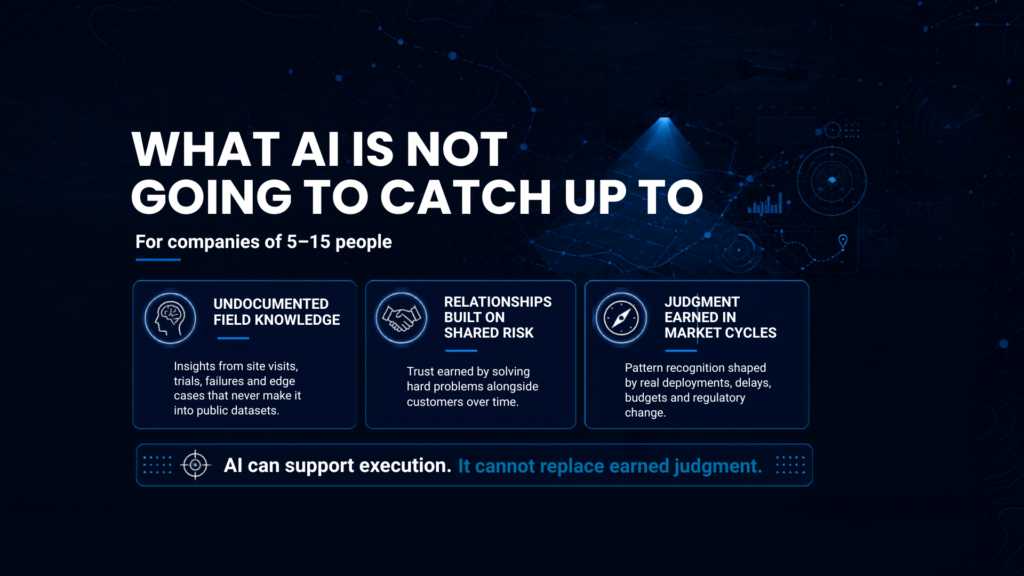
The knowledge that has not been documented yet.
AI models trained on FAA filings, incident reports, technical papers, operator manuals, case studies, and economic reports are already useful. They will get more useful. But they are always working from what has already been written down in the public domain.
The current failure mode your customer mentioned on a Tuesday site visit, the integration issue that surfaced in last week’s field trial, the use case that almost worked and the specific reason it did not: those are powerful data points and none of that is in a training dataset. It is in the head of someone who was there.
I started researching and working on commercial UAS use cases and the technology at Insitu in 2012. Wildfire, agriculture, oil and gas, mining, railroads, utilities. Almost none of what we were working through existed in published literature at the time, or in anyone’s experience, yet for that matter, we achieved many industry firsts.
The knowledge lived in conversations, in failed deployments (these were the learning opportunities), in the gap between what the sales deck promised and what the aircraft actually did in the field. AI would have been a step behind then. It is a step behind now. Practitioners who stay current with their customer base will always operate one cycle ahead of what any model can synthesize from public sources.
Relationships built on shared risk, not contact lists.
AI outreach tools are already generating personalized cold emails at scale (we all get them), mapping relationships, and identifying warm paths to almost any contact. Volume is being automated. That part of the relationship equation is going to get noisier, faster, unfortunately.
What cannot be automated well is depth. A customer who has watched you work through a hard problem alongside them. Who has seen you tell them something they did not want to hear, and watched it turn out to be right. Who calls you before they call anyone else because of a track record built over years of direct engagement. That is not a sequence. That is not a workflow.
A customer who has been in the room with you when something went wrong, and watched how you handled it, is not going to replace that with an outreach sequence no matter how well it is written. The human desire for that kind of relationship does not weaken as the tools get better. It gets stronger. I think we can all feel that.
That dynamic extends to the fundraising table, too. Investors do not wire money because a deck was well-optimized. They move when conviction has been built through a relationship, and when someone they trust says look at this one.
Judgment calibrated by being wrong in the right markets.
Twenty-five years across semiconductors, enterprise computing, manufacturing, and UAS teaches you something that no training dataset captures: what customers say they will do versus what they actually do when the budget gets cut, when the integration gets hard, when the regulatory path shifts unexpectedly, when the factory line is impacted by a sole-sourced item delay. That calibration comes from living through technology adoption cycles long enough to see the same mistakes repeat in new industries. AI does not have scar tissue.
It does not know what it felt like to watch a promising use case collapse because the end customer’s procurement cycle took 18 months, and the startup ran out of runway at month 14. That pattern recognition is earned, not retrieved. If you have it, recognize its value. If you don’t have it yet, surround yourself with those who do.
The Operational Data Question
Real-world deployment data: flight hours, failure modes, sensor performance logs, and field conditions that no simulation anticipated. That is a legitimate asset. Synthetic data and simulation environments are improving, and in controlled conditions, they are closing gaps in some domains.
But the real world continues to generate edge cases that no model trained on synthetic data has seen. The company that collected real field data owns something defensible, provided they treat it like an asset.
Most early-stage startups are not doing this. The data sits in pilot reports, in a field tech’s spreadsheet, in someone’s email thread. It exists but it is not structured, not governed, and not queryable.
That’s understandable. It’s hard and it’s admin work that doesn’t seem to move the needle forward right now. It’s a long-term play. AI can be genuinely helpful here. Use its ability to organize, synthesize, and track trends within your data. A well-laid-out data system built with AI in mind can reduce the workload for these tasks considerably.
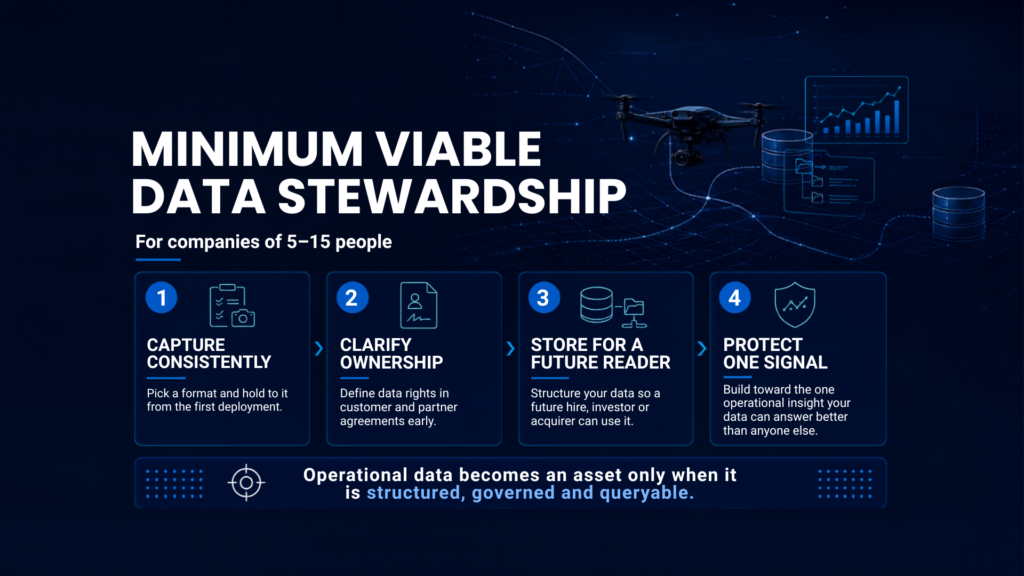
Minimum viable data stewardship for a company of 5 to 15 people:
- Capture consistently from day one. Pick a format and hold to it from the first deployment. Retrofitting structure onto unorganized historical data is expensive and usually not worth the effort.
- Clarify ownership before the engagement starts. Data rights language belongs in every customer and partner agreement, not in the due diligence conversation two years later.
- Store with a future reader in mind. You do not need a data science team today. You need a structure that a future hire, an investor, or an acquirer can actually work with.
- Identify one signal worth protecting. What operational question can your data answer that no competitor can? Build toward that answer with intention. A focused dataset with a clear insight outperforms a large dataset with no one responsible for it.
Building the Company, Not Just the Founder
Here is the part that matters most for fundability.
If the IP lives only in the founder’s relationships and head knowledge, you have something valuable and something fragile. Investors will see that clearly. The goal is migration. What the founder knows and has earned needs to move into the company’s operating record before it becomes a ceiling.
Document customer outcomes in writing, not just in the founder’s verbal retelling. Give a new hire processes they can learn and execute without the founder in the room. Make sure customer relationships exist at the company level, not only through one person’s phone. The founder’s domain knowledge and relationships are the ignition. The company’s validated proof base is what sustains it.
Build both simultaneously. Make the company functional without the founder faster than feels comfortable. That is not a loss of control. That is the definition of a company worth buying.
What This Means for How You Build
The founders building well right now are not choosing between AI and experience. They use AI hard on execution and mindless work tasks. They protect the time it frees up for the things that cannot be automated: direct customer time, field presence, and advisor relationships with people who carry current market knowledge and experience.
The startups that treat AI as a replacement for that investment are building on a foundation any well-funded competitor can replicate. The ones that use AI to accelerate and free up time for the irreplaceable work are building something that holds.
Your IP is not your code. It is not your deck. It is not your framework. It is what you know, who trusts you, and what you have proven in the field. Protect that accordingly.
Dan Fuller is the founder of Clarify Consulting LLC, a fractional business development firm serving UAS, robotics, and autonomy companies. He has spent 16 years in the drone industry, including a decade at Boeing/Insitu, and works with early-stage OEM and software companies entering North American markets. Beyond the Fog publishes on LinkedIn.