

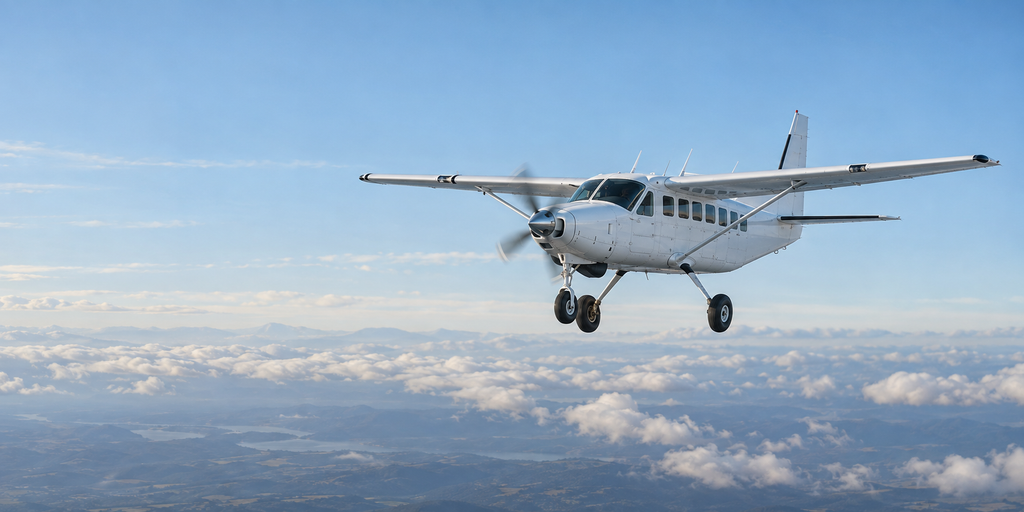
A Cessna Caravan takes off, climbs, cruises and lands while a ground operator monitors the flight from fifty miles away. A safety pilot remains onboard during testing, but the aircraft is controlled autonomously. The company behind the system, Reliable Robotics, recently closed $160 million in funding, bringing its valuation close to $1 billion.
The aircraft itself is already familiar to cargo operators. Reliable Robotics built its autonomy system around the Cessna 208B Caravan, one of the most widely produced and trusted cargo aircraft in service today. Its approach shows why retrofitting proven platforms is becoming an increasingly important strategy across the autonomy market.
Why are autonomous retrofit systems gaining ground
I first saw a version of this two years ago, while supporting the certification side of an autonomous conversion for an existing helicopter platform. At the time, it felt like an edge case. It does not feel like one anymore. Over the past six months especially, I have watched the same move play out again and again across defense, agriculture, and commercial aviation in the United States, Europe, and Asia.
Different sectors, different regulators, and different customers. The strategic approach, however, is the same.
The companies pulling ahead in autonomy right now are not necessarily the ones building the most advanced new machine. They are the ones asking a simpler question: what does the customer already own, already trust, and already know how to service, and what would it take to make that platform autonomous?
Here are a few examples I see on the ground, in the air, and on the water.
How does autonomy retrofit work in agriculture
Quint Pottinger farms 2,200 acres at Affinity Farms in New Haven, Kentucky. Land his family has worked since 1788. Last year, he sold two large tractors and their planters and replaced them with one small 135 horsepower tractor and a retrofit kit from Sabanto. He cut his equipment capital by roughly 70 percent and planted his entire crop without sitting in the driver’s seat.
Sabanto recently closed an oversubscribed Series B led by Leaps by Bayer, one of the largest agriculture companies in the world. Bayer already believes autonomy works. What convinced them here was the specific approach: upgrading the equipment farmers already own instead of asking them to buy something new.
Four thousand miles away in Zwolle, Netherlands, a small startup called Nivavi is making the same bet with a product called Bart. Founder Niels van Vilsteren put it plainly: tractor manufacturers themselves are not building this, so his company is adding autonomy to equipment that is already fully optimized. Neither Sabanto nor Nivavi are trying to replace the tractor. Both are trying to replace the driver and solve a workforce problem in the industry.
Why are proven helicopters becoming autonomous platforms
Robinson Helicopter established a dedicated business unit, Robinson Unmanned, in March of this year, organized around a simple observation: its existing helicopters are the common thread across three very different autonomy programs, each built by a different company.
Rotor Technologies builds an agricultural spray platform on the R44. Skyryse is developing a Group 4 defense UAS on the R66 for intelligence and surveillance work. Sikorsky is developing a cargo variant, also on the R66, under a Marine Corps contract. Robinson did not design any of these autonomy systems. It makes the helicopters underneath all three.
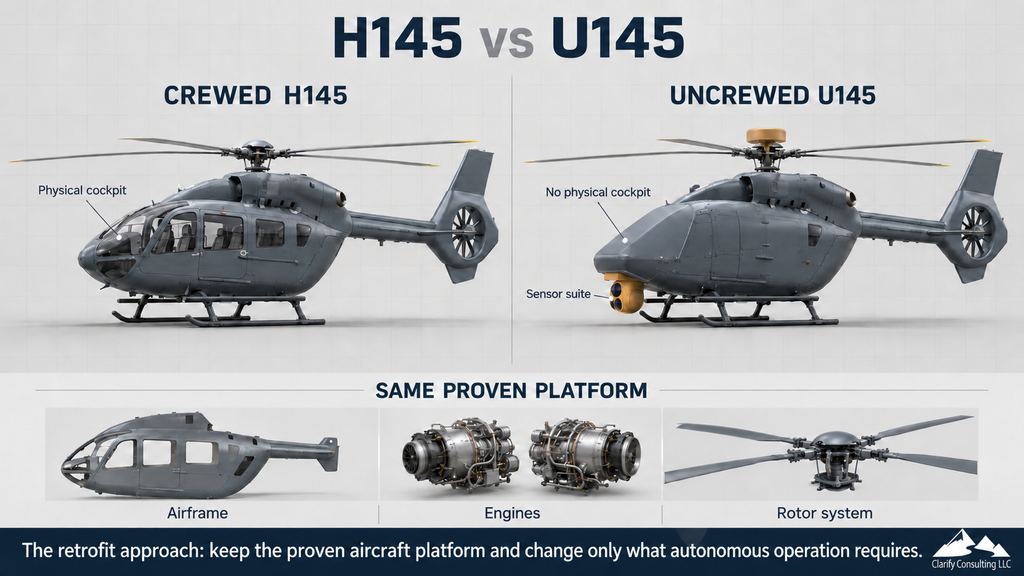
Airbus made a version of the same bet at a much larger scale. In June, at the ILA Berlin airshow, Airbus Helicopters unveiled the U145, an uncrewed variant of its popular H145, a helicopter with more than 1,800 built and 8.5 million flight hours logged. Airbus’s own CEO described it as combining the proven airframe, power, and useful load of the H145 with the autonomy of a UAS. It is the same aircraft operators already trust, with the cockpit removed.
How are cargo aircraft using autonomy retrofit
Reliable Robotics, the Cessna Caravan company mentioned earlier, now has more than 200 system commitments, including a 30 unit order from ASL Aviation, and is targeting summer cargo routes in the next few months. It is one path toward the more than 2,500 Caravans already in service that could eventually carry the same retrofit.
Merlin Labs is doing something similar at a different altitude. Its autonomy system completed a major design review milestone this spring on the military C 130J. In May, the company announced that it is extending the same system into commercial cargo aircraft under a new product line, Condor. The software stays the same. The airframe changes to whatever the customer is already flying.
Can autonomous navigation be retrofitted to commercial ships?
The pattern is not limited to aircraft. It shows up on the water too.
Avikus, the autonomous navigation arm of HD Hyundai, the world’s largest shipbuilder, retrofits its HiNAS Control system onto existing tankers, bulk carriers, and container ships in about three days, with no dry docking required.
In January, Avikus signed the largest single autonomous navigation contract to date, covering forty vessels for HMM, South Korea’s national shipping line. The company has now completed more than one hundred retrofit installations and has over seven hundred units on order.
At this point, the examples span ground vehicles, helicopters, fixed wing cargo aircraft, and commercial ships across agriculture, defense, and commercial shipping. Enough companies are making the same choice independently that it stops looking like a coincidence.
When does autonomy retrofit stop making sense?
None of this means new hardware is a mistake. It means new hardware needs a real reason.
Even Sea Machines, a company built almost entirely on retrofitting existing vessels, is developing a purpose built new ship for the United States Navy’s Modular Attack Surface Combatant program.
A combat mission with its own power, endurance, and survivability requirements is not always something an existing hull was designed to deliver. An airframe or hull caps your available power, payload, and speed at whatever it was built for. You can change how a platform operates. You cannot always change what it was physically built to do.
That does not make retrofit the automatic right answer. It makes retrofit the right first question. Clean sheet development still makes sense when the mission genuinely needs something the existing platforms cannot provide, including more power, range, or payload than the original design ever accounted for.
Why can retrofit autonomy reduce certification risk?
I have sat on the certification side of exactly this kind of project, converting an existing crewed helicopter platform toward an autonomous medical delivery use case. The advantage is not theoretical to me.
When you build a new aircraft from scratch, you are certifying and engineering everything at once: the airframe structure, propulsion, flight characteristics, and the new autonomy layer, all as one unproven package. When you start from a platform that is already certified, mature, and trusted by operators, the certification and engineering effort narrows to the part that is actually new. You are not validating again whether the airframe can fly.
Regulators and operators already accept that. You are proving that the autonomy layer is safe. That distinction alone can take years and millions of dollars off a program timeline, and it is the real reason this pattern keeps winning across sectors that otherwise have almost nothing in common.
This is not unique to the FAA. EASA has its own version of the same mechanism: a supplemental certificate for modifying an aircraft that already holds a type certificate, rather than certifying a new one from scratch. Building on what is already trusted is not only an American regulatory method. It appears on both sides of the Atlantic because it reflects how aviation safety gets proven over time.
What should autonomy companies ask before building new hardware?
As a boy I grew up on a farm, on tractors and combines, working fields for my dad and other farmers from around age 11, and coming home from college during breaks to do the same work for extra money. I still own several hundred acres of dryland crop land today, growing canola, wheat, and lentils most years. I have worked in agricultural drone applications since 2012, and I still work with agriculture clients today.
That combination of ground level experience in agriculture and hands on engineering and certification experience in aviation is what allowed me to see this pattern early, and to see it as one pattern instead of five unrelated examples. If you are a founder building something purpose built and new, that is not automatically the wrong call.
But it is worth asking honestly whether the market actually needs a new machine, or whether it needs the machine it already trusts to do more without a person in the seat. The founders winning capital and contracts right now are the ones who did that math before they started building, not after.

For companies developing autonomous systems, the decision begins with the mission. Does it require an entirely new platform, or could an aircraft, vehicle or vessel that customers already operate be adapted to perform it? That question affects certification, capital requirements, customer confidence and the time needed to reach the market.
I am interested in how other autonomy companies are approaching this decision. If you are currently evaluating retrofit and clean sheet development, share what is shaping your choice in the comments. Dan Fuller is the founder of Clarify Consulting LLC, a fractional business development firm serving UAS, robotics and autonomy companies. He has spent 16 years in the drone industry, including a decade at Boeing and Insitu, and works with early stage OEM and software companies entering North American markets. Beyond the Fog publishes on LinkedIn.